DeKalb was first settled in the 1830's being known as Huntly's Grove and Buena Vista. It was officially incorporated as the city of DeKalb in 1856. A large bicentennial celebration was held in 2006.
DeKalb has long been a center for agriculture (click here). DeKalb County is a leader in corn, soy bean, and hog production. It was in DeKalb that Joseph Glidden invented barbed wire in 1874, which developed DeKalb into the nation's major manufacturing center of barbed wire. DeKalb became known as the "Barb City". DeKalb's Henry Gurler developed a process for purifying milk ahead of Louis Pasteur.
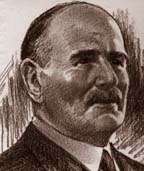
Jacob Haish one of the manufacturers of barbed wire began the Jacob Haish Manufacturing Company which also produced gasoline engines, manure spreaders, cream separators, and several other products. Click here for more information.
For the souvenir edition of the DeKalb Chronicle from Saturday, January 9, 1892,
Click here.
For a photo record of the construction of DeKalb's historic 1905 Post Office (torn down in 1995), Click here.

DeKalb was home to the nation's first county farm bureau and was a center for genetics research with DeKalb Genetics, which was later acquired by Monsanto. Thomas Roberts Sr and Charlie Gunn were the pioneers of hybrid seed corn.
Del Monte operated a major processing center for canning corn and peas. DeKalb Feeds were milled and Caterpillar Challenger agricultural tractors were manufactured in DeKalb.
The Melvin Clark Piano company had a large plant in DeKalb which was eventually purchased by the Wurlitzer Company in 1919. In 1935 Wulitzer moved its headquarters to DeKalb, and made it the only manufacturing plant in the world producing their famous pianos. The plant closed in the 1970s, and they moved their corporate headquarters to Gurler Rd. At that location they assembled the mightiest Wurlitzer organ in the world.
Mightiest Wurlitzer Organ
Melvin Clark Piano Co.
Click here for an excerpt from the DeKalb Centennial Volume published in 1956.
Many immigrant groups were influential in the community, click here for a history of DeKalb's finnish community.
Traveling through the USA, it's hard to avoid a connection with DeKalb. You see miles of barbed wire, the famous winged ear signs of DeKalb hybrids along highways, or Caterpillar's Challenger tractors working in fields, all these products at one time called DeKalb, Illinois their home. Those giant blue Harvestore silos dotting the landscape continue to be manufactured in DeKalb.
 NIU's Altgeld Hall
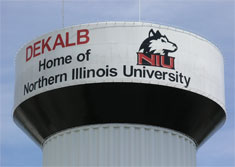
As a center for education DeKalb is home to Northern Illinois
University (Illinois' 2nd largest university campus with over 25,000 students). Visit their website
for more detailed information. Only 10 minutes away is Kishwaukee College, an outstanding two
year community college.
DeKalb is named for General Baron Johan DeKalb. DeKalb came with Lafayette from France to serve in the Revolutionary War against the British. He served under General George Washington at Valley Forge where he was a trusted officer and friend. He fought in several battles leading the Maryland and Delaware Continentals. His last battle against British troops took place in Camden, South Carolina. It was in this battle at Camden that General DeKalb died after being wounded 11 times during a valient effort on August 19, 1780.